


Concert Review: TEN Transforms Dallas into an Intimate Showcase of Movement, Music, and Identity

Outside The Bomb Factory in Dallas, October rain greeted an audience whose enthusiasm showed no signs of cooling. Inside, the atmosphere was considerably warmer. Fans gathered in groups, some dressed in Halloween costumes ranging from Disney princesses to more imaginative interpretations, including one attendee dressed as a friendship bracelet. It was an unconventional but fitting prelude to an evening built around artistic individuality.
The venue was packed, yet the atmosphere retained a sense of intimacy rarely associated with the elaborate spectacle of K-pop performances. On October 29, TEN, the Thai-born singer and dancer known for his work with NCT and WayV, demonstrated that commanding a stage has considerably less to do with its dimensions than with the artist occupying it.
Before TEN appeared, a colorful introductory VCR and atmospheric smoke established the visual direction of the evening. Anticipation built across the room until the opening notes of “STUNNER” brought the audience to a near-deafening response.
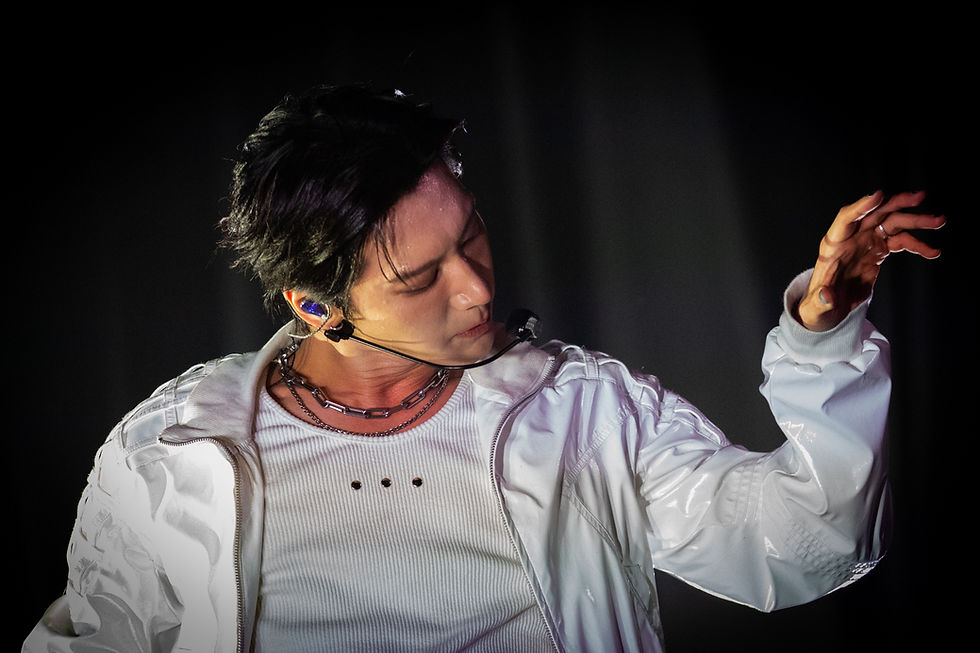
TEN emerged in an all-white dance ensemble, its reflective material catching the shifting lights and creating a kaleidoscopic effect as he moved. His presence was immediately commanding. There was no lengthy introduction or gradual buildup to his performance identity. Within moments, the stage belonged to him.
What followed was an examination of the qualities that have made TEN one of K-pop’s most distinctive performers.
The Language of Movement
Dance has long been central to TEN’s artistic identity but watching him perform in person reveals something that recorded choreography cannot entirely communicate.
His movements combine sharp technical precision with an almost liquid fluidity. Each transition appears intentional, yet rarely mechanical. His ability to shift between controlled isolation and expansive movement gives the choreography a dynamic quality that extends beyond simply executing difficult sequences.
During “Nightwalker,” that physical vocabulary became particularly compelling.
Accompanied by a group of backup dancers, TEN delivered choreography that balanced precision with sensuality. The dancers contributed additional texture and intensity, creating layered visual compositions that reinforced the song’s darker atmosphere.
Rather than relying exclusively on speed or complexity, the performance emphasized control. Subtle changes in posture, deliberate pauses, and carefully executed movements became just as important as the more physically demanding sections.
There is an important distinction between an artist who performs choreography and one who communicates through it.
TEN consistently demonstrated the latter.
His understanding of movement extends into his facial expressions, which frequently carried the emotional weight of the music. A carefully timed glance, an understated smile, or a shift in his expression could transform the atmosphere of an entire sequence.
For photographers, those details are invaluable. For an audience, they make the performance feel personal.

Beyond the Choreography
Although TEN’s dancing naturally commanded considerable attention, his ability to connect with the audience proved equally important.
Throughout the evening, he demonstrated an approachable personality that contrasted with the intensity of his stage performances.
During one interaction, TEN joked with the crowd about being “bad at math,” referencing the numerical element of his stage name. His English was confident and conversational, allowing the exchange to feel spontaneous rather than rehearsed.
These moments offered a glimpse of the personality behind the meticulously constructed performances.
Onstage, TEN could project an almost intimidating level of confidence. Between songs, that same performer appeared comfortable sharing humor and engaging directly with the people who had come to see him.
The contrast was effective because neither side felt disconnected from the other.
TEN’s confidence was particularly evident in his use of eye contact. Whether acknowledging the audience or looking directly toward a camera, he demonstrated a clear understanding of how small gestures can create powerful moments.
His expressions were not incidental additions to the choreography. They were part of the performance itself.
An Electric Room
The production favored a concentrated visual experience, allowing TEN’s performance to remain the central attraction.
Lighting played a significant role in establishing the show’s atmosphere, shifting between vibrant colors and more dramatic compositions that emphasized movement and silhouette.
The audience remained engaged throughout the nearly two-hour performance, responding enthusiastically to songs including “OUTWEST,” “WATER,” and “BAMBOLA.”
Each offered a different opportunity for TEN to demonstrate the versatility of his solo material.
The crowd’s enthusiasm was particularly noticeable during recognizable songs, when the room erupted with cheers and collective excitement.
Yet the evening’s effectiveness was not simply the result of audience participation.
TEN maintained the momentum through choreography, expressive staging, and the confidence of a performer who understands precisely how to direct attention.
Even within the relatively intimate venue, the production achieved a sense of scale through movement and lighting rather than relying on oversized staging.
A Moment Through the Lens
One of the evening’s most visually compelling moments occurred during “STUNNER.”
Standing alone, TEN was illuminated from behind by pink and white lighting. His arms and hands extended toward the audience, creating a striking composition against the illuminated stage.
It was the kind of moment that demonstrates the relationship between concert photography and live performance.
The lighting established the composition, but TEN’s physical expression gave it meaning.
His posture, the positioning of his hands, and the emotion visible in his eyes transformed what could have been a conventional performance photograph into something more intimate.
For a brief moment, the elaborate elements surrounding him became secondary.
The focus was entirely on the artist and his ability to communicate without speaking.

An Artist Beyond Expectations
TEN has spent years establishing himself as a formidable performer within the K-pop industry. His reputation as an exceptional dancer is hardly a recent development, and his work across multiple musical projects has consistently demonstrated his technical ability.
Yet his Dallas performance illustrated why technical excellence alone does not fully explain his appeal.
There are countless talented dancers working in contemporary pop music. Far fewer possess the ability to make complex choreography appear effortless while maintaining an unmistakable artistic identity.
TEN belongs to that smaller category.
His performance was sensual without depending entirely on provocation, technically impressive without becoming an exercise in athleticism, and confident without sacrificing moments of genuine connection.
More importantly, the evening reinforced the significance of his continued development as a solo artist.
Within NCT and WayV, TEN has already established a recognizable presence. On his own stage, however, his artistic instincts occupy the entire frame.
Every movement, expression, and interaction becomes part of a performance shaped around his individual identity.
Dallas witnessed an artist whose abilities have been evident for years, but whose solo work provides an opportunity to appreciate their full range.
TEN has long been recognized for setting an extraordinary standard in dance. On October 29, he demonstrated that his greatest strength may be something less easily measured: the ability to make an audience feel the intention behind every movement.
For TEN, choreography is not simply something performed to music. It is another way of telling the story.


Comments